
Quick answer
Water under a washer usually comes from a short list of places: a loose hose connection, the pump filter cap, the drain hose, the door seal or too much detergent. Find the leak first, then fix that spot. Expect 20–40 minutes, and most fixes cost nothing.
Water on the floor is stressful, but the washer is rarely beyond repair. The trick is to stop guessing: dry the floor and the back of the washer, run a short cycle, and watch where the first drop appears. That tells you which fix to try, so you do not take apart the wrong part.
This guide follows Samsung’s U.S. leak guide, LG’s front load leak help and Whirlpool’s product help. If the water is not leaving the tub at all, see our guide to a washer not draining. If the leak comes with a drain problem, see our washer not draining guide. If your washer also shows an error code, check our Samsung washer error codes or LG washer error codes list.
Where the water comes from
Match what you see to the likely cause, then jump to that fix.
| Where you see water | Cause | Difficulty | Cost |
|---|---|---|---|
| Back of the washer, near the faucets | Loose or worn inlet hose connection | Easy | $0 to tighten; $130–$250 if a pro replaces hoses |
| Front bottom corner | Pump filter or drain cap not sealed | Easy | $0 |
| Behind the washer, or the floor drain | Drain hose loose, or household drain backing up | Easy–Medium | $0 |
| Under the door | Dirty or torn door seal | Easy | $0 to clean |
| Suds or water from the dispenser or rear vent | Too much or non-HE detergent | Easy | $0 |
| Still leaking after the checks above | Damaged hose or a fault inside the washer | Hard | $125–$450 average repair |
Costs come from HomeAdvisor’s washing machine repair guide (updated June 17, 2026) and are national averages for all brands.
Samsung points out that some water dripping from the door of a front loader right after you open it is normal. It only counts as a leak if water drips while the door is closed.
5 fixes for a leaking washer
Safety first
Unplug the washer and turn off both faucets before you touch any hose or filter. Put towels and a shallow pan under the work area, because the machine still holds water. Never run a cycle with a hose or filter removed.
Fix 1: Check the hoses and connections (10 minutes)
- Turn off the water and look at every hose on the back of the washer. LG says to check for kinks, cracks and punctures.
- Samsung asks you to inspect both ends of each hose, including the rubber and the o-rings inside the ends.
- Whirlpool says both ends of the inlet hoses need hose washers and every connection must be tight. LG says to replace worn rubber washers.
- Replace any hose that is cracked or damaged. Whirlpool says damaged hoses need replacing.
Fix 2: Clean and reseat the pump filter (15 minutes)
Tools: towel, shallow pan, soft-bristle brush.
- Unplug the washer and open the small service panel at the bottom front. LG places it in the bottom-left corner.
- Drain the residual water from the small hose into the pan.
- Turn the filter counterclockwise to remove it, both brands agree. Clean it and its base with a soft-bristle brush and warm water.
- Turn it back clockwise until snug. LG warns not to over-tighten. LG also says to close the drain hose stopper tightly.
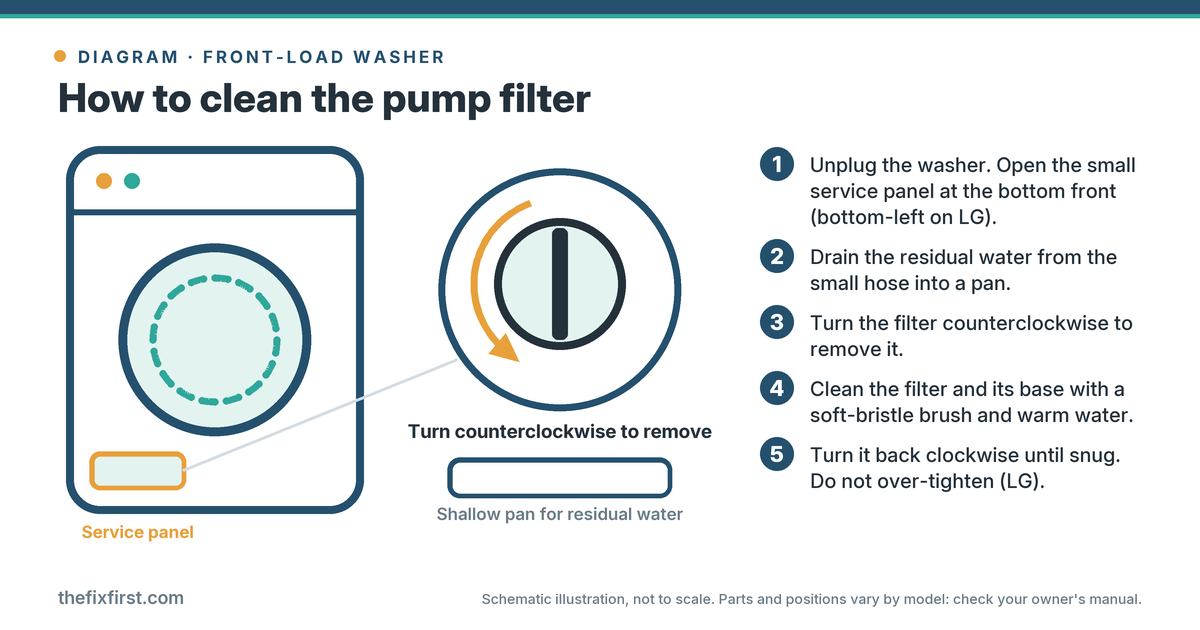
Samsung recommends cleaning this filter at least once a month, or every 40 washes, whichever comes first.
Fix 3: Check the drain hose and the household drain (10 minutes)
Samsung says the drain hose must go 6–8 inches into the drain pipe and be held with a zip tie so it cannot slip down. Its standard drain height is 18–96 inches, and it says not to use extension kits.
Whirlpool says the household drain must carry at least 17 gallons (64 liters) per minute. LG suggests pouring a gallon of water into the drain to test it. If it backs up, the clog is in your plumbing, not the washer.
Fix 4: Clean the door seal (10 minutes)
Fold the seal back and look for debris. Samsung notes that even a few hairs can cause a leak. LG says to pull back the lip of the gasket and clean underneath with 3/4 cup of vinegar or bleach in 1 gallon of water. LG warns never to use straight bleach, because it can damage the gasket.
If the seal is torn, LG says to request a repair.
Fix 5: Use the right amount of detergent (5 minutes)
Too many suds can push water out of the dispenser or a rear vent. LG says to use HE detergent only and reduce the amount, often to just 1–2 tablespoons. Samsung says to stay at or below the MAX line in the drawer, or follow the manufacturer’s advice if it is lower. Whirlpool adds that non-HE detergent causes suds that can lead to leaks.
Run a tub clean cycle monthly, as LG suggests, to clear buildup.
When to call a technician for a leaking washer
Call the manufacturer or a local pro if the leak continues after all five fixes, or if the seal or a hose is damaged beyond a simple swap. Samsung and Whirlpool say to request service if the problem persists after troubleshooting.
HomeAdvisor puts the average washing machine repair at $125–$450 (updated June 17, 2026). Check the warranty first and tell the technician what you already tried. If the washer is old and the quote is high, our repair or replace guides can help you decide.
Washer Leaking From the Bottom FAQ
Is it normal for a front load washer to drip a little?
Samsung says water may drip from the door after you open it, and that is normal. It is a leak only if water drips with the door closed.
Can too much detergent make my washer leak?
Yes. LG, Samsung and Whirlpool all link excess suds, or non-HE detergent, to leaks. Use HE detergent and measure it.
How often should I clean the pump filter?
Samsung says at least once a month, or every 40 washes, whichever is more frequent.
Should I keep using a leaking washer?
It is better to stop. Water on the floor can damage the flooring, and a loose connection can get worse. Fix the leak before the next cycle.
Could the leak be from my house plumbing instead?
Possibly. Whirlpool says to check that the household drain is not backing up and to inspect nearby plumbing for leaks.